
News
Gdańsk Develops Satellite Monitoring Center for the Baltic Sea Using Advanced Space Technologies
At the end of March 2026, a major strategic step was taken to strengthen Poland’s capabilities in space and satellite technologies. Following a landmark agreement signed on March 20 during the PowerConnect 2026 energy fair at AmberExpo, Gdańsk has been selected as the home for the new Baltic Sea Monitoring Center (Ośrodek Monitorowania Morza Bałtyckiego - OMMB).
.jpg)
photo: USGS/NASA Landsat Program, SYKE / MarineFinland.fi
Rather than relying on fragmented systems, the OMMB will integrate advanced satellite data with ground- and sea-based information sources. The result will be a comprehensive observation network designed to support environmental protection, infrastructure oversight, and maritime security.
A Broad Cross-Sector Partnership
The foundation of the OMMB is a "triple-helix" partnership connecting government institutions, academia, and regional development agencies. Each participant contributes complementary competencies to create a regional hub for innovation and applied research:
Polish Space Agency (POLSA): Coordinating national space sector activities and driving the development of satellite technologies.
Gdańsk University of Technology (PG): Providing crucial research infrastructure, technological expertise, and scientific facilities.
Pomeranian Special Economic Zone (PSSE), Pomeranian Development Agency (ARP), and InvestGDA: Supporting investments, fostering startups, and commercializing innovative space-tech solutions.
"Satellite technologies are now a cornerstone of national security and the modern economy. They allow us to monitor developments, respond quickly to threats, and develop new services," said Andrzej Domański, Poland’s Minister of Finance and Economy.
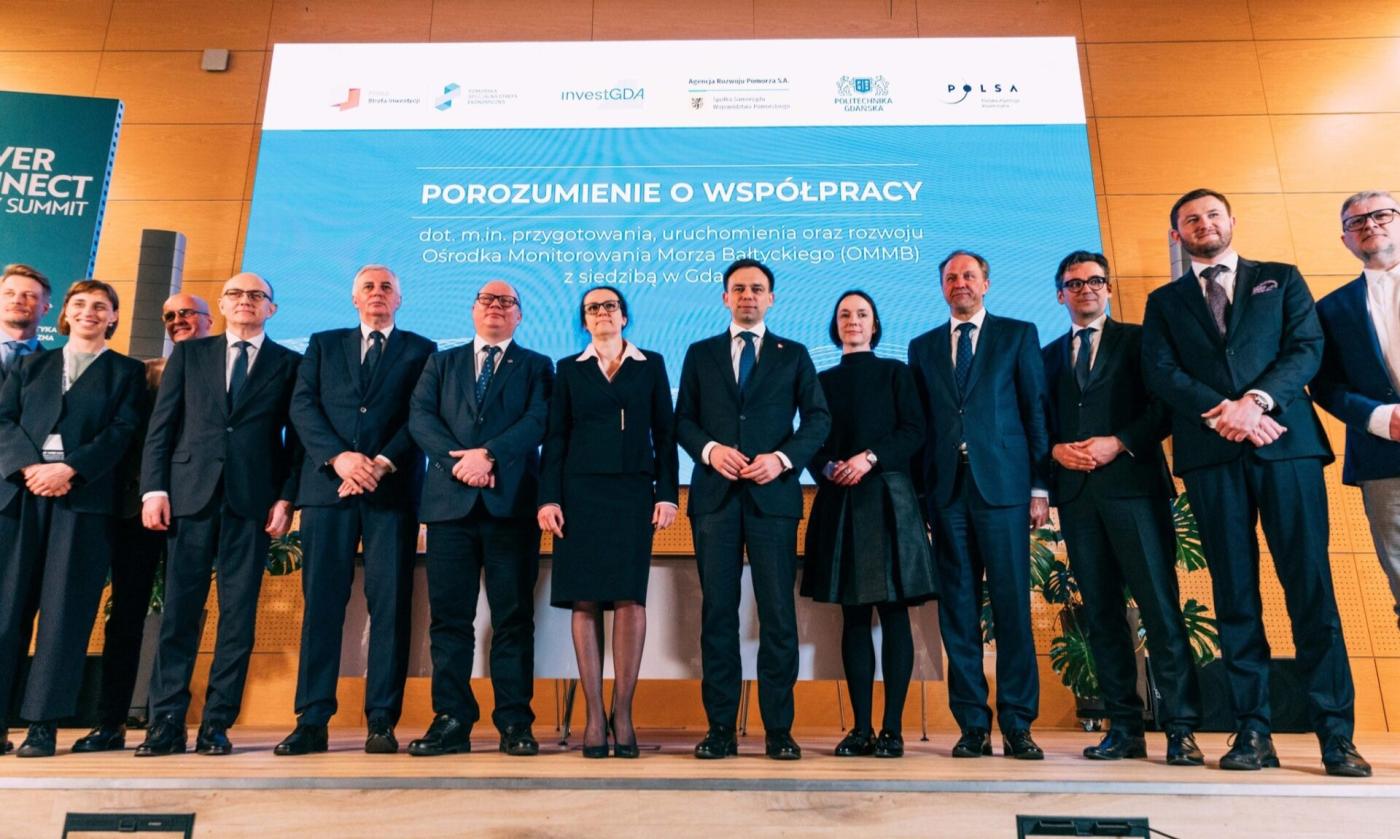
photo: Maciej Wróblewski / InvestGda
The Strategic and Ecological Importance of the Baltic
The Baltic Sea is no longer just a transport and tourist route; it has become a critical area on the geopolitical map of Europe. Since 2024, it is practically considered an internal sea of NATO, making regular and reliable maritime reconnaissance a genuine necessity.
The OMMB will provide rapid detection of threats, enabling continuous monitoring of highly sensitive zones and issues, including:
Security & Infrastructure: Protecting major shipping routes, commercial ports (Gdańsk, Gdynia, Szczecin-Świnoujście), and critical offshore energy infrastructure, including expanding wind farms, subsea cables, and the planned coastal nuclear power plant. It will also track the activities of the Russian "shadow fleet."
Ecological Protection: Observing eutrophication and harmful algal blooms, tracking marine pollution, and mitigating risks associated with sunken WWII wrecks and submerged chemical weapons.
"Our goal is to create a facility that leverages satellite data for the Polish economy and citizen safety. The Baltic Sea has strategic significance, and we need modern tools to monitor it," emphasized Mirosław Kamiński, CEO of PSSE.
The Power of SAR Technology and Sovereign Satellites
The establishment of the OMMB coincides with significant advancements in Poland's sovereign space-based reconnaissance capabilities. A core element of this project is the utilization of Synthetic Aperture Radar (SAR) technology. Unlike optical satellites, SAR systems do not depend on sunlight and can pierce through cloud cover, fog, and nighttime conditions. For the Baltic Sea region, where limited visibility dominates much of the year, this guarantees uninterrupted, 24/7 surveillance.
This capability was recently highlighted by the scheduled launch of the MikroSAR reconnaissance satellite (part of the POLSARI constellation) on March 30, 2026, from a US Space Force Base. This orbital asset provides the high-resolution data necessary for the OMMB to maintain total maritime awareness.
Fueling Regional Innovation and Startups
Beyond its security and environmental functions, the OMMB is intended to strengthen the Pomeranian innovation ecosystem. The center will roll out specialized educational and training programs in IT, artificial intelligence, data analytics, and cybersecurity to build a highly skilled local workforce.
Gdańsk’s role in the European space sector was recently cemented by gaining the status of a European Space Agency Business Incubation Centre (ESA BIC), joining Warsaw and Rzeszów. Piotr Ciechowicz, Vice President of the Pomeranian Development Agency, highlighted that this cooperation opens access to lucrative EU funding mechanisms. Mieczysław Struk, Marshal of the Pomeranian Voivodeship, reinforced this ambition: "We will do everything to make innovation our Baltic specialty."
The practical application of these technologies is already evident in the region. For example, the ESA BIC-graduate startup Mobile Monitoring has successfully developed an autonomous water-quality system that bridges the gap between on-site measurements and Earth observation by combining satellite data with drones and smart buoys.
Poland in the European Context
This initiative perfectly aligns with the objectives of the EU Space Programme for 2021-2027, which carries a guaranteed budget of over €14 billion aimed at strengthening European technological autonomy and competitiveness.
(2).png)
Ultimately, the Baltic Sea Monitoring Center is expected to evolve into a multidisciplinary hub, bridging the needs of the state, industry, and academia. By integrating sovereign satellite data with cross-sector cooperation, Gdańsk is setting a new benchmark for integrated maritime monitoring, ensuring the Baltic region remains safe, ecologically protected, and economically vibrant.