
Gdansk County
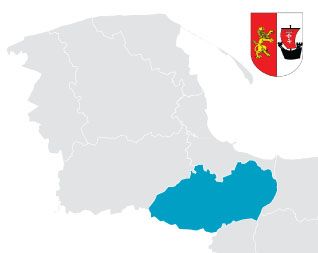
| Residents/Population: | 131 728 |
|---|---|
| Area: | 794 km2 |
| Expenditure per capita: | 1 158,84 zł |
| Website: | www.powiat-gdanski.pl |
| Rulers/Leaders: | |
| Jarosław KarnathStarost | Piotr OłowskiChair of the County Council |
The seat of Gdańsk County is Pruszcz Gdański, whose history dates back to the Roman Empire. Today, Gdańsk County is an administrative unit separate from the City of Gdańsk, yet it has been inextricably linked to this city for centuries. Strategic road investments completed in recent years have connected the two areas even more closely.
In the 4th century AD, the so-called northern Amber Route ended in the area of present-day Pruszcz Gdański. An ancient settlement - a trading post - was located here. In modern times, these lands were revived along with the development of Gdańsk in the 14th century, and since then their fates have been closely interconnected. When counties returned to the administrative map of Poland in 1999, Gdańsk County included Pruszcz Gdański and 7 municipalities: Cedry Wielkie, Kolbudy, Pruszcz Gdański (rural municipality), Przywidz, Pszczółki, Suchy Dąb, and Trąbki Wielkie.
Several strategic transport arteries run through the county. Until 2012, the Tri-City Bypass built in the 1970s ended here; however, thanks to the construction of a new 18-kilometer section of the Southern Gdańsk Bypass, it was extended to Koszwały, providing residents with convenient connections to the center of the metropolis and reducing transit traffic on county roads. The national road S7 (Gdańsk - Warsaw) and the A1 motorway (the so-called Amber One), which is part of the international E75 transport route from Helsinki to Athens, also pass through the county. The strategic Polish north-south E65 railway line runs through it as well, along with the SKM (Fast Urban Railway) system serving the Gdańsk Metropolitan Area, which links Gdańsk County with Gdańsk, Wejherowo, and Lębork on one side, and with Tczew on the other.
As part of improving public transport, all municipalities of Gdańsk County joined the Metropolitan Transport Union of the Gulf of Gdańsk (MZKZG), established in 2007. This integration introduced common rules for the organization of public transport in the municipalities and gives residents and tourists the opportunity to use a metropolitan ticket, which allows travel on various types of public transport (buses, trams, SKM) across more than a dozen cities and municipalities.
As part of numerous investments co-financed by EU structural funds, the authorities of the municipalities and Gdańsk County have also implemented many important road investments that further improve the quality of transport infrastructure. The bypass of Pruszcz Gdański, opened in 2011, can be considered the most important of them.
In 2012, the county began the largest investment in its history implemented with EU support. This refers to the renovation of the Radunia Canal, built during the Teutonic Order period, which is the main element of flood protection for the southern part of the metropolis. The funds obtained by the county for this purpose amounted to PLN 24 million. This investment is also an example of good cooperation between the county, the municipality and town of Pruszcz Gdański, and the City of Gdańsk.
Private entrepreneurship is also a strong pillar of the county's economy. Many thriving and innovative companies operate within its territory. The largest include: the telecommunications and IT company DGT, cosmetics companies Ziaja and Oceanic, the International Energy Training Center, Amber Brewery, food sector enterprises Rabat Pomorze and TAN VIET International, and the dynamically expanding Nowak Meat Plant.
Additionally, individual parts of the county have their own competitive advantages. Depending on the municipality, the main sectors of the economy in the county are: services and tourism (Przywidz, Trąbki Wielkie), industry, as well as agriculture (Suchy Dąb, Cedry Wielkie, Pruszcz Gdański municipality).