
Kartuzy County
Kartësczi pòwiôt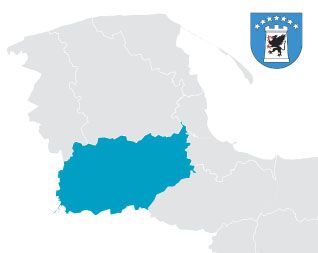
| Residents/Population: | 153 813 |
|---|---|
| Area: | 1121 km2 |
| Expenditure per capita: | 1 482,38 zł |
| Website: | www.kartuskipowiat.com.pl |
| Rulers/Leaders: | |
| Bogdan ŁapaStarost | Mieczysław WoźniakChair of the City Council |
Kartuzy County is located in the most picturesque part of the Kashubian Lake District, commonly known as Kashubian Switzerland. It is a land of several hundred lakes (part of the so-called Radunia Circle), forests, landscape parks, and the highest elevation in the Polish lowlands. At the same time, it is one of the strongest cultural centers of the Kashubians, the only ethnic group in Poland whose language has the status of a regional language.
Tourism is gaining increasing economic importance for the residents of the county. In its territory, we can find numerous facilities providing a permanent accommodation base for residents of the metropolis and visitors from outside the metropolitan area. Agritourism, in particular, is becoming an increasingly valued opportunity to increase local income and enhance the attractiveness of the region.
Kashubian regional culture plays an important role for the county's residents; therefore, numerous traditional cultural events take place in surrounding towns, such as the Kashubian Fair in Kartuzy, the Strawberry Harvest in Złota Góra near Kartuzy (the largest outdoor event in Kashubia!), as well as folk festivals, organ concerts, and art exhibitions. A major attraction is the Centre for Education and Regional Promotion, where visitors can see, among other things, the famous upside-down house in Szymbark, an open-air museum, the Siberian Exile House, and the longest wooden plank in the world.
When visiting Kartuzy County, one should not miss the Sanctuary of Our Lady Queen of Kashubia in Sianowo, which has become an important pilgrimage site in recent years. It is also worth seeing the neo-Baroque wooden Church of St. Joseph in Pomieczyno and the historic Church of St. Andrew in Przodkowo, built of hewn stone, both valuable remnants of the region’s past.
In the most varied part of the landscape between Kartuzy and Kościerzyna lies the highest elevation of the South Baltic Lake District region. This is Wieżyca (328.6 meters above sea level), often referred to as the Kashubian Olympus. The highest peak in Kashubia is known for its rich tourist offer. In winter, it offers skiing and snowboarding in comfortable conditions, with a ski lift and floodlit ski slopes for night skiing. During the winter season, it attracts thousands of residents from the entire metropolis seeking winter recreation. Additional attractions include sleigh rides, horseback riding, and ice fishing.
In summer, it is worth climbing the John Paul II Kashubian Observation Tower to admire the beauty of the Szymbark Hills. For recreational activities, the bathing beach in Ostrzyce is highly recommended, where pedal boats, kayaks, and sailboats are available. The diversity of fish species in the lakes (roach, eel, perch, bream, vendace, pike) also attracts many anglers.
There are as many as 173 lakes larger than 1 hectare in the county, as well as several hundred smaller ones, which is why the region is referred to as the Kashubian Lake District.
The area strongly encourages outdoor sports. The most popular routes include the blue cycling and walking trail (Kartuzy–Kosy–Chmielno) and three Nordic walking trails (through Bilowo, Smętowo Chmieleńskie, and Kosy) of varying lengths and difficulty levels.
Traces of prehistoric settlement can also be found in the county. It is worth visiting the burial mounds in Węsiory (Sulęczyno municipality), dating back to the turn of the Bronze and Iron Ages, as well as the stone circle cemeteries from the 1st and 2nd centuries AD.
All these advantages make Kartuzy County an increasingly attractive place to live. Over the last decade, a 15 percent population increase has been recorded, and this upward trend is expected to continue, especially given its location. The county lies relatively close to the metropolitan core, and a major transport route also runs through it—national road No. 20, connecting the metropolis with Szczecin and further on with Berlin.