
Malbork County
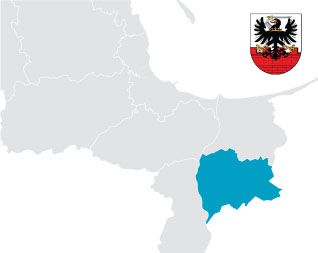
| Residents/Population: | 60 647 |
|---|---|
| Area: | 494 km2 |
| Expenditure per capita: | 1 804,53 zł |
| Website: | www.powiat.malbork.pl |
| Rulers/Leaders: | |
| Piotr SzwedowskiStarost | Andrzej RychłowskiChair of the County Council |
The Malbork County is referred to as the “Granary of the North”. It covers the picturesque area of the Vistula Fens (Żuławy Wiślane), which are known for their high-quality agricultural soils, producing yields even several times higher than those in the rest of the country. Alongside agriculture, local business is also developing dynamically. This is supported by a strong business environment created by well-developed technical infrastructure, numerous economic institutions, and a public sector that is favorable to cooperation with investors. For tourists, Malbork County is primarily associated with its capital – the town of Malbork – and the tourist showcase of this region: the monumental Teutonic Castle.
High-quality soils and excellent natural conditions support the development of agriculture. The county is dominated by the cultivation of cereals, rapeseed, sugar beets, legumes, and herbs. Modern cattle and pig farming is also well developed. The county lies in the Żuławy region, famous for having the most fertile soils in Poland. The yields achieved here are generally 2–3 times higher than the national average. High productivity and production quality have led to Malbork County being called the “Granary of the North”.
A strong business environment is created by well-developed technical infrastructure, economic institutions such as the Enterprise Development Association and the Malbork Chamber of Commerce, as well as a well-developed financial services sector (there are 15 bank branches operating in the county, a credit guarantee fund, and 11 insurance companies). Additionally, factors supporting the creation of new enterprises include a skilled workforce, numerous international contracts, and low production costs – approximately 27% lower compared to metropolitan centers. Companies with foreign capital participation operate successfully in the county, including: the “Leier Malbork” Building Materials Plant, the “Nyborg-Mawent” Malbork Fan Factory, “Prino-Plast” Hygiene Products Manufacturing, Eurofins Stiens Laboratory, and Madex–Kościeleczki.
The greatest development opportunities are available for investors in the tourism and agri-food sectors. Major companies located in the county include: Malbork Chemical Works “ORGANIKA”, Malbork Sugar Factory S.A., Malbork Machine Tool Factory “Pemal” S.A., the “Malborżanka” Confectionery Production Plant, and Elewarr.
In 2003, the investment offer of Malbork County was expanded with areas included in the Pomeranian Special Economic Zone, with a total area of 8.1 hectares, which contributed to increasing the attractiveness of the region. Important regional economic events are also organized in Malbork County, including the Żuławy Agricultural Fair (June) and the Autumn Horticultural and Seed Fair (September). Both events take place in the town of Stare Pole.
The picturesque landscapes of the Vistula Fens and the Iława Lake District, clean air, and magnificent monuments attract many visitors to the area, who can stay in numerous accommodation facilities. Agritourism farms are particularly popular in this region.
The tourist showcase of Malbork County is its capital, featuring the largest brick Gothic castle in Europe, located on the right bank of the Nogat River, which once served as the capital of the Teutonic Order. Every year, over half a million tourists visit this monumental structure, and it is also the main venue for the largest recurring cultural events in the county (including Magic Malbork and the Siege of Malbork). The town also offers other attractions. A unique place is the Żuławy Ceramic Village, where visitors can produce tiles and other ceramic and clay products themselves.
An unforgettable experience is a gondola ride along the defensive walls of the town and castle, as well as cruises on the Nogat River. During a boat trip, visitors can learn about the history of the region and fully admire the natural beauty of this unique landscape. The cruise route includes the castle, a nature reserve, and a system of inclined planes – the only functioning system of its kind in the world – as well as two locks, one of which, in Biała Góra, is among the largest of its type in Europe. This river ensures free navigation between the Vistula, the Jagiellonian Canal, and the Vistula Lagoon. However, river cruising is not the only form of active recreation for which Malbork County is known. Cycling tourism has become very popular, and excellent conditions have been created for it here. Cyclists have 81 kilometers of bicycle routes at their disposal. By bike or on foot, it is worth visiting several highly recommended monuments: the Parish Church of St. Joseph in Kałdowo, St. Matthew’s Church in Nowy Staw, the 14th-century Gothic church in Myszewo, and the Parish Church of St. Ursula in Lichnowy.