
Pruszcz Gdanski Town
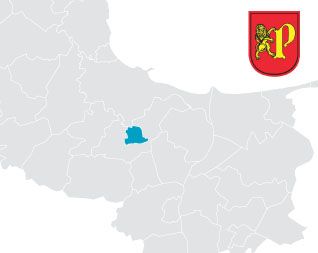
| Residents/Population: | 32 171 |
|---|---|
| Area: | 16 km2 |
| Expenditure per capita: | 7 814,40 zł |
| Website: | www.pruszcz-gdanski.pl |
| Rulers/Leaders: | |
| Janusz WróbelMayor of the Town | Małgorzata Czarnecka-SzafrańskaChair of the City Council |
Pruszcz Gdański is a city located 10 km from the center of Gdańsk, at the junction of the Gdańsk Fenlands (Żuławy Gdańskie) and the Kashubian Lake District (Pojezierze Kaszubskie). The city is a vital industrial, service, commercial, and cultural center. It covers an area of 16.5 km² and has over 30,000 residents.
Pruszcz Gdański is an extremely important road and railway transport hub, situated along national road No. 91 and the main railway line connecting Gdańsk with Warsaw, Bratislava, and Vienna. The start of the A1 motorway and the Tricity bypass are located just a few hundred meters from the investment areas.
The location of Pruszcz Gdański relative to the most important transport hubs of Pomerania, its proximity to Gdańsk, a large consumer market, and educated, enterprising residents are the determinants of the city's investment attractiveness. It is here, by the A1 motorway junction, that the Baltic Investment Zone (Bałtycka Strefa Inwestycyjna) is located. Companies such as Poczta Polska, Cargill, Crown Cork, LPP S.A., and many others operate within its area. In this context, an asset of Pruszcz Gdański is also the proximity and easy access to the Lech Wałęsa Airport, which is located 20 km from the aforementioned Baltic Investment Zone.
A valuable element of Pruszcz Gdański, which has already blended into its identity, is the local airport. Located in the southeastern part of the city, it enables operations for small civil aircraft. The airport is currently used by the 49th Air Base and the Gdańsk Aero Club.
Pruszcz Gdański is a city where it is good to live, work, and relax. A modern residential and commercial development was created in the city center, for which the city received the Honorary Award of the Society of Polish Town Planners in 2009 in a national competition for the best-developed public space.
In the southern part of the city, the reconstructed Trade Factoria (Faktoria Handlowa) and the International Amber Route from the Roman influence period await visitors. The scale of this investment makes it a unique tourist and archaeological undertaking nationwide. The Factoria is a lively place that connects history with the present. Visitors to the Factoria can see, among other things, the Chief's Hut (Chata Wodza) - a museum exhibition combining the latest multimedia solutions with a wealth of archaeological artifacts and beautiful amber exhibits; the Market Hall (Hala Targowa) - a place where you can encounter living archaeology; the Amber Craftsman's Hut (Chata Bursztyniarza), featuring a reconstructed workspace along with the artisan's products; and the Blacksmith's Hut (Chata Kowala), where the household decor and forge have been precisely recreated.
Numerous outdoor events and concerts featuring top Polish and even European performers take place on the Factoria grounds. In the immediate vicinity of the Factoria lies the International Baltic Cultural Park, featuring an amphitheater, a children's playground, a multi-purpose sports field, and a skate park. As part of an initiative called "Faktoria Kultury" (Culture Factoria), many interesting events for all ages are held here, including performances by the Summer Stage of the Wybrzeże Theatre, music concerts, cabaret shows, and theatrical performances for children. Several tourist routes intersect near the Factoria, such as the Radunia River Hydroelectric Plants Route, the Mennonite Route, and the Amber Route connecting the Factoria with Gdańsk. The city of Pruszcz Gdański is steadily developing its network of pedestrian and cycling trails, which serve as an excellent opportunity for physical activity for both residents and tourists.
The city's most valuable monument is hidden in the center - the Gothic Parish Church of the Exaltation of the Holy Cross. The church preserves its carved wood and polychrome interior fittings, including a Renaissance pulpit, a gallery, and a Baroque organ casing. Until 1945, it also housed a 16th-century Antwerp altar, which is now a valuable exhibit at the National Museum in Warsaw.
The city of Pruszcz Gdański has a well-developed, yet not oversaturated, commercial network with medium-sized supermarkets. It features a clean river with relaxation spots, free intra-city public transport, new playgrounds and sports fields, two modern swimming pools, and a modern city cinema. This creates a comprehensive offer that attracts new residents and entrepreneurs not only from neighboring rural areas but also, in a very large percentage, from the much larger cities of the metropolis.
Pruszcz Gdański - more than you expect, your city, your future.