
News
Historic Energy Records: The Pomeranian Area Ports Shield Europe and Ukraine from the Global Shipping Crisis
Over the past six months, the geopolitical landscape of Central and Eastern Europe has undergone a structural realignment, with the seaports of the Pomeranian Area becoming the fundamental backbone of the new energy architecture. Amidst growing geopolitical instability and the shipping crisis in the Middle East — caused by threats to maritime shipping that disrupted traditional supply chains — the ports of Gdansk and Gdynia have transformed from a backup route into a key guarantor of energy security for the entire continent and Ukraine.
ph: Tadeusz Urbaniak / port.gdynia.pl
Historic Transshipment Records and Crisis Management
In March 2026, the ports of the Pomeranian Area recorded an all-time high in diesel fuel transshipment. According to the latest market data, seaborne diesel supplies to Poland's Baltic ports reached a historic maximum of nearly 776,000 tons in a single month, significantly exceeding the previous record set in May 2022 (667,000 tons).
Q1 2026 Performance Highlights:
Port of Gdansk: Received 308,000 tons of fuel in March (a massive jump from 54,000 tons in February).
Port of Gdynia: As the main import hub for independent traders, it handled almost 290,000 tons.
Quarterly Total: Polish ports imported 1.34 million tons of diesel fuel in the first quarter of 2026, nearly double the volume of the same period in 2025 (730,500 tons).
This surge helped meet domestic market needs during a planned maintenance turnaround at the Gdansk refinery and enabled Poland to assist landlocked neighbors. When Slovakia faced oil supply disruptions in early 2026, a €40 million deal was struck to reverse the flow of the Czech section of the Druzhba pipeline, allowing Bratislava to receive Western crude oil supplied through the Port of Gdansk.
ph: portgdansk.pl
Massive LNG Strategy: Supplying the Region
Poland is executing a comprehensive strategy to become a regional gas hub, shifting its focus toward supplying neighboring countries with liquefied natural gas (LNG).
FSRU 1 (Gdansk): Construction has begun on the first Floating Storage Regasification Unit in the Gulf of Gdansk, with a capacity of 6.1 billion cubic meters per year, scheduled for launch in 2028.
FSRU 2: Driven by massive demand, operator Gaz-System officially launched a binding "Open Season" procedure in April 2026 to book capacity for a second vessel, adding another 4.5 billion cubic meters annually.
Nearly half of this regasified LNG is expected to be exported to the Czech Republic, Slovakia, Ukraine, and Lithuania. In January 2026, Polish ministers officially offered to supply Slovakia with American LNG via the Poland-Slovakia interconnector to phase out Russian gas ahead of the 2027 EU ban. Furthermore, the Stork II gas pipeline project is being revived for direct supplies to the Czech Republic.
A Strategic Lifeline for Ukraine
The role of the metropolitan ports in supporting Ukraine amid the ongoing war cannot be overstated. Polish infrastructure directly bolsters the resilience of the Ukrainian economy:
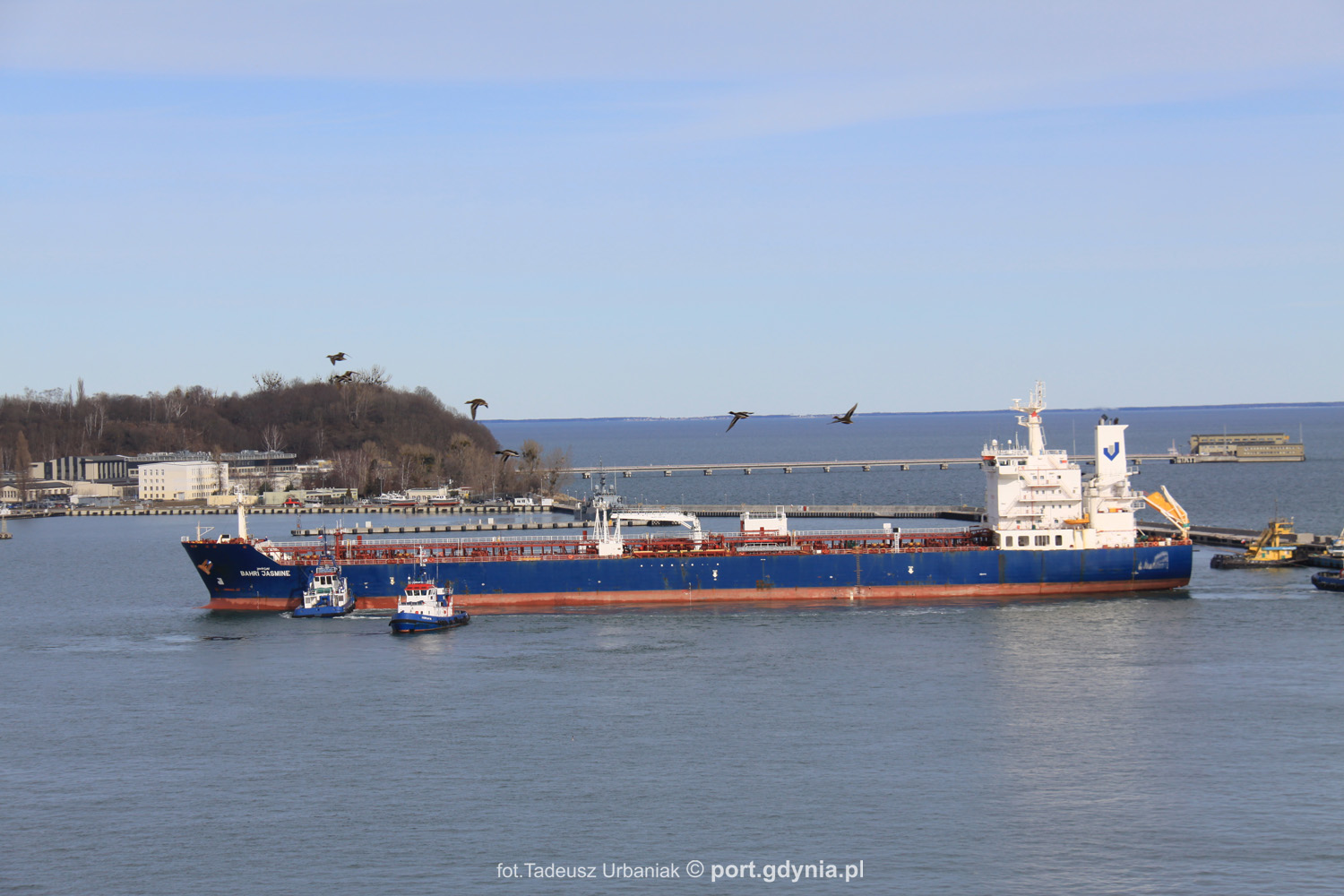
Fuel Supplies: In March 2026, the volume of diesel exported to Ukraine via Polish ports (primarily Gdynia and Świnoujście) rose to 160,500 tons.
Natural Gas: In response to the winter heating crisis, gas operators agreed to increase export capacity to 18.4 million cubic meters per day by the end of April 2026.
2025 Retrospective: Ukraine received 2.1 billion cubic meters of gas through Poland (over 30% of its total imports), including 600 million cubic meters of US LNG.
ph: Tadeusz Urbaniak / port.gdynia.pl
Impact on Domestic Business and Infrastructure Investment
The energy transformation is bringing enormous dividends to the Polish economy and stimulating local industries:
Gdynia Modernization: A 174 million PLN contract awarded to the Polish company Budimex will nearly double the Liquid Fuel Transshipment Station's capacity from 3.2 million to 6 million tons annually.
Gdansk Expansion: Construction has begun on a sixth transshipment station at the Naftoport base, capable of servicing the world's largest tankers (over 300 meters in length).
ORLEN Group: The state energy giant reported a net profit of 11.2 billion PLN for 2025, allocating a record 32.6 billion PLN in capital investments. Notably, one-third of the group's revenue now comes from international markets.
Geopolitics and the American Partnership
Poland's transformation into an energy hub is radically altering its foreign relations. Ties with neighboring countries are shifting from purely political to highly technological and strategic partnerships. Simultaneously, the partnership with the United States has reached new heights: Poland received 62 US cargoes of LNG in 2025, cementing its status as a key bridge between American energy resources and European security.
The realization of these infrastructure projects, alongside plans for the Outer Port (Port Zewnętrzny) in Gdynia, definitively establishes the Pomeranian Area as the premier logistics and energy center of Central and Eastern Europe.